
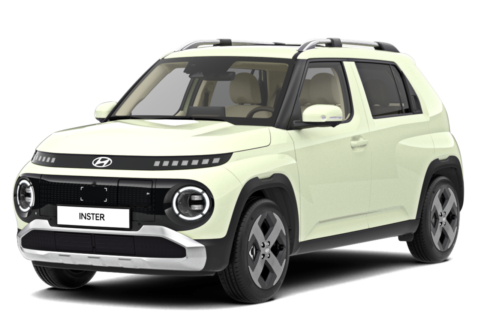
Hyundai Inster Vertex electric FWD automatic
Sustainability rating
2025
96%


9.7
10
Clean Air
Exhaust emissions
good
10.0
10
good
10.010
| NMHC | NOX | NH3 | CO | PN | PM | Score | |
|---|---|---|---|---|---|---|---|
| Legal test (WLTP) | 8.08 | ||||||
| Warm weather | 10.010 | ||||||
| Highway | 10.010 | ||||||
| Winter cold start | 10.010 | ||||||
| Winter warm start | 10.010 |
good
10.010
| NMHC | NOX | NH3 | CO | PN | PM | Score | |
|---|---|---|---|---|---|---|---|
| Real-world mixed drive | 10.010 | ||||||
| Short city trip | 10.010 | ||||||
| Congestion | 2.02 |
Non-exhaust emissions
good
9.2
10
good
5.56
| Result | Score | |
|---|---|---|
| Influence of mass | 2.53 | |
| Wheel alignment | 1.01 | |
| Accelerator response | 2.02 |
good
5.66
| Result | Score | |
|---|---|---|
| Brake dust mitigation | 0.04 | |
| Brake dust containment | 0.06 | |
| Recuperative braking - warm test | 5.66 |
Additional Life Cycle Assessment information
good
9.1
10
Pollutants
*Exhaust emissions are not contributing to the score in Additional Life Cycle Assessment information because they are scored in the Exhaust emissions section above.
9.5
10
Energy Efficiency
Energy demand
good
9.5
10
good
9.710
Legal test (WLTP)
15.1
kWh/100 km
Warm weather
16
kWh/100 km
Highway
25.7
kWh/100 km
Winter cold start
27.4
kWh/100 km
Winter warm start
22.9
kWh/100 km
good
9.710
Total LCA energy consumption
*Direct propulsion energy share is not shown, it is included in ‘Fuel/energy supply’
Energy source share in total LCA consumption
Rolling resistance
adequate
8.1
10
9.8
10
Greenhouse Gases
Exhaust GHG emissions
good
10.0
10
In laboratory
Legal test (WLTP)
0
g CO₂-eq./km
Warm weather
0
g CO₂-eq./km
Highway
0
g CO₂-eq./km
Winter cold start
0
g CO₂-eq./km
Winter warm start
0
g CO₂-eq./km
Additional Life Cycle Assessment information
adequate
6.6
10
Total LCA GHG Emissions
*The scoring does not consider the direct exhaust GHG emissions at the tailpipe, because they are scored separately in ‘Exhaust GHG emissions’ above.
Vehicle Life Cycle Average Emissions 28 (+/-)
(Best 24 | Worst 31)
Specifications
- Vehicle class City and Supermini
- System power/torque 84.5 kW/147 Nm
- Engine size n.a.
- Declared consumption 15.1 kWh/100 km
- Declared driving range Overall 360 km City 493 km
- Declared CO2 n.a.
- Declared battery capacity Usable (net) 49.0 kWh Installed (gross) 49.0 kWh
- Mass 1,412 kg
- Heating concept Heat pump
- Tyres 205/45 R17 88V
- Emissions class AX
- Tested car KMHB55119SW01XXXX
- Publication date 11 2025
Show less
Show more
Driving Experience
Consumption & Range
good
Estimated actual consumption
What consumption can be expected in real world conditions?
good
| Conditions | Urban | Rural | Highway | Mixed | |
|---|---|---|---|---|---|
| Warm weather |
14.4
|
16.9
|
20.7
|
17.1
|
kWh/100 km
|
| Cold winter |
25.5
|
21.8
|
27.7
|
25.1
|
kWh/100 km
|
Driving range
What driving range can be expected in real world conditions?
adequate
| Conditions | Urban | Rural | Highway | Mixed | |
|---|---|---|---|---|---|
| Warm weather | 382 | 326 | 267 | 322 |
km
|
| Cold winter | 216 | 253 | 199 | 219 |
km
|
Accuracy of display
Is the consumption figure on the display correct?
good
Cold Winter Performance
poor
Driving range benefit of pre-warming
How much further can you drive in winter, if the car is pre-warmed?
adequate
| Type | Driving Range Benefit | Result |
|---|---|---|
| Urban trip | + 91km | |
| Mixed trip | + 40km |
Cabin heating
Does the vehicle get warm quickly in winter?
poor
| Type | Front | Rear |
|---|---|---|
| Head area |
741s
|
217s
|
| Footwell |
1,216s
|
The rear left footwell area reached the temperature in 1,186 seconds and in the right in 1,256 seconds.
Additional heating functions
What functions can be used to improve heating comfort?
| Y/N | Fitment | |
|---|---|---|
| Heat pump | Standard for the tested version | |
| Seat heating front | Standard for the tested version | |
| Seat heating rear | ||
| Steering wheel heating | Standard for the tested version | |
| Scheduled pre-heating of seats | Standard for the tested version | |
| Scheduled steering wheel pre-heating | Standard for the tested version | |
| Scheduled cabin air pre-heating | Standard for the tested version | |
| Smart cabin heating management | Standard |
Cabin thermal insulation
How well does the cabin maintain its temperature?
poor
Good
Adequate
Poor
Charging Capability
adequate
Battery pre-conditioning
Does the vehicle have the ability to optimize the battery temperature for fast charging?
| Manual | Automatic | |
|---|---|---|
| Battery pre-conditioning |
Fast charging
adequate
Charging time
How quickly can the battery charge?
Recharged range gain per charging time
How long do you need to fast charge to drive a certain distance?
Charging power
How quickly does energy flow into the battery, depending on its charge level?
Home charging efficiency
Is charging at home efficiently utilizing the energy withdrawn from the grid?
adequate
| Home charging efficiency |
89%
|
|
| Maximum home charging power | 11 kW | Standard |
Bidirectional charging
How capable is the vehicle of supplying energy from its battery to other devices or systems?
adequate
Power output
3.6
kW
Fitment: Standard for the tested version
Compatibility
|
Vehicle-to-Load (V2L)
The inlet or the interior socket can provide AC power through an electrical domestic socket.
|
Vehicle-to-Household (V2H)
The vehicle can provide power to a household through a charger.
|
Vehicle-to-Grid (V2G)
The vehicle can return power to the grid.
|
| Fitment: Standard for the tested version | ||
Grid Integration
|
Basic
No integration (just a socket for a stand-alone load). No scheduling option. Very basic visualisation.
|
Limited
Energy management system through the vehicle app (timers availability and power monitoring). Dedicated interface in the car, with mobile app monitoring.
|
Advanced
Advanced: Advanced settings available such as tariff and consumption control, linked to distributor energy prices. Advanced real time energy flow visualization. AI powered suggestions for optimal usage.
|
Green NCAP comments
Most of the estimated warm weather real-world consumption values of the Inster are seen as 'good' , while the predicted cold weather figures are all in the 'adequate' range. Although the 49 kWh battery is relatively small, the achievable driving ranges in urban and rural scenarios are adequate for both warm and cold weather conditions. Highway range, however, drops to 'poor', making it clear that the motorway isn't Inster's preferred space. The consumption readings on the board computer display are accurate.
- Most of the estimated warm weather real-world consumption values of the Inster are seen as 'good' , while the predicted cold weather figures are all in the 'adequate' range. Although the 49 kWh battery is relatively small, the achievable driving ranges in urban and rural scenarios are adequate for both warm and cold weather conditions. Highway range, however, drops to 'poor', making it clear that the motorway isn't Inster's preferred space. The consumption readings on the board computer display are accurate.
- Drivers are advised to preheat the vehicle before cold winter trips, if possible. By doing so, an increased driving range can be achieved. The possible values are not high for the Inster, but are still a valuable contribution to a longer driving range in cold conditions. The small Hyundai failed to impress with quick cabin heat-up in cold winter conditions. A fast temperature increase was measured only around the rear head area, while the other positions needed much longer. However, the Inster can be quite well equipped with additional heating functions, which may compensate for the slow cabin air warm-up and provide quick comfort to the driver and the front passengers. Green NCAP tested a high trim, which featured all the additional extras. The cabin thermal insulation is evaluated as 'poor'.
- The vehicle's home charging efficiency is standard with a grid-to-battery-output value of 88.5%. The fast DC charging is seen as adequate. In its higher trims, the car can be equipped with vehicle-to-load charging functionalities, which allows it to supply 230 V to external devices. The implementation of this function in a vehicle of this class is remarkable and deserves praise. Potential buyers are advised to study in detail the available equipment options, as they can vary between countries and additional adapters and sockets are not always included.
Read more
Read less
Also covered by this rating
Variants
Hyundai Inster
49 kWh Cross electric FWD automaticHyundai Inster
49 kWh Prime electric FWD automaticHyundai Inster
49 kWh Trend electric FWD automaticHyundai Inster
49 kWh Select electric FWD automatic
Our verdict
The Inster is Hyundai's new fully electric supermini. It impresses with both its sustainability scores and good equipment. Additionally, Euro NCAP recently awarded it 4 stars for safety. In Green NCAP it excelled with 5 stars and an average score of 96%.