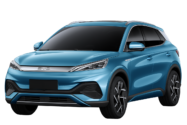
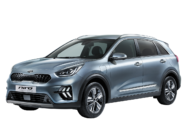
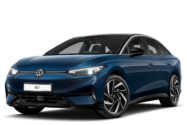
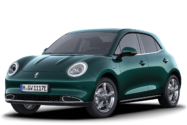
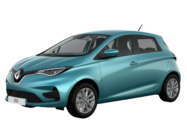
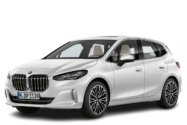
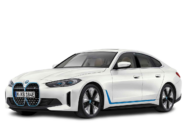
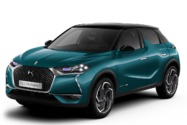
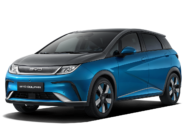
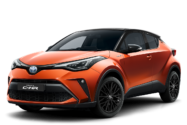
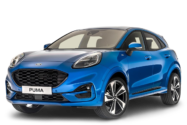
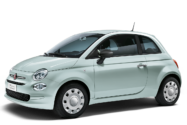
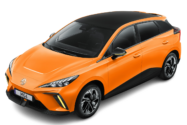
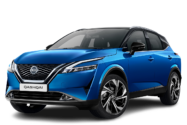
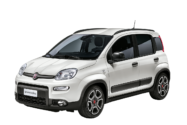
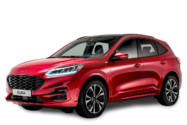
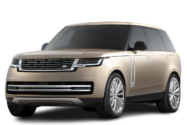
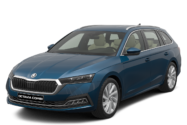
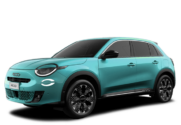
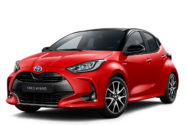
This page allows you to search amongst the ratings of all cars tested by Green NCAP. Ratings are listed by year and sorted by date of publication. You can also sort them alphabetically by make & model, by star rating, by indexes and by powertrain type.
Green NCAP’s 2025 rating scheme is very significantly different from all previous years. No direct comparison is possible between 2025 ratings and earlier ratings, owing to the inclusion of Life-Cycle Analysis (LCA) in all three areas of assessment: Clean Air, Energy Efficiency, and Greenhouse Gases. The two-stage approach used from 2022 to 2024 has evolved in favour of a single set of tests. Some of the laboratory tests are carried forward from previous years, and some new tests are introduced. A single on-road drive continues to be a part of the assessment. In previous ratings, some elements of LCA – those related to the upstream production of fuel and/or electricity - were included in the assessment of Greenhouse Gases. In other words, the greenhouse gases created during the supply of energy was added to the gases emitted by the car itself during Green NCAP’s tests. In 2025, LCA is applied to all three areas of assessment including Clean Air, which considers pollutant emissions. And the analysis now extends to the whole life cycle of the vehicle, from production (taking into account where in the world this is done), through the useful life of the vehicle (including maintenance etc) to final destruction and the materials that can be recovered at that stage. This narrows the gap between combustion-engined vehicles like petrol or diesel, and pure electric vehicles. Now, only the most sustainably produced and efficient cars will get a good rating. Even electric cars, which have no tailpipe emissions, will be penalised if their production puts a big demand on the environment. Read more: https://www.greenncap.com/wp-content/uploads/2025-Green-NCAP-Protocols-Backgrounder.pdf
Sustainability Ratings
Driving Experience
Make & Model
Class
Sustainability rating
Consumption & Range
Cold Winter Performance
Charging Capability
Average score
Clean Air
Energy Efficiency
Greenhouse Gases
Engine
Mercedes-Benz CLA
250+ EQ Technology Progressive Line electric…
250+ EQ Technology Progressive Line electric RWD automatic
Small Family Car
Jun 2026
good
Estimated actual consumption
Driving range
Accuracy of display
adequate
Driving range benefit of pre-warming
Cabin heating
Cabin thermal insulation
adequate
Fast charging
Home charging efficiency
Bidirectional charging
91%
8.610
9.410
9.510
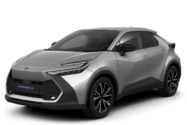
Toyota C-HR
Icon Hybrid…
Icon hybrid FWD cvt
Small SUV
Jun 2026
good
Estimated actual consumption
Accuracy of display
adequate
Cabin heating
Cabin thermal insulation
not applicable
66%
6.810
7.710
5.510
MINI Cooper
C Favoured Trim…
C Favoured Trim petrol FWD automatic
Green NCAP’s 2025 rating scheme is very significantly different from all previous years. No direct comparison is possible between 2025 ratings and earlier ratings, owing to the inclusion of Life-Cycle Analysis (LCA) in all three areas of assessment: Clean Air, Energy Efficiency, and Greenhouse Gases. The two-stage approach used from 2022 to 2024 has evolved in favour of a single set of tests. Some of the laboratory tests are carried forward from previous years, and some new tests are introduced. A single on-road drive continues to be a part of the assessment. In previous ratings, some elements of LCA – those related to the upstream production of fuel and/or electricity - were included in the assessment of Greenhouse Gases. In other words, the greenhouse gases created during the supply of energy was added to the gases emitted by the car itself during Green NCAP’s tests. In 2025, LCA is applied to all three areas of assessment including Clean Air, which considers pollutant emissions. And the analysis now extends to the whole life cycle of the vehicle, from production (taking into account where in the world this is done), through the useful life of the vehicle (including maintenance etc) to final destruction and the materials that can be recovered at that stage. This narrows the gap between combustion-engined vehicles like petrol or diesel, and pure electric vehicles. Now, only the most sustainably produced and efficient cars will get a good rating. Even electric cars, which have no tailpipe emissions, will be penalised if their production puts a big demand on the environment. Read more: https://www.greenncap.com/wp-content/uploads/2025-Green-NCAP-Protocols-Backgrounder.pdf
Sustainability Ratings
Driving Experience
Make & Model
Class
Sustainability rating
Consumption & Range
Cold Winter Performance
Charging Capability
Average score
Clean Air
Energy Efficiency
Greenhouse Gases
Engine
FIAT 600
1.2 T3 Hybrid…
1.2 T3 Hybrid petrol FWD automatic
Small SUV
Apr 2026
good
Estimated actual consumption
Accuracy of display
not applicable
not applicable
62%
6.810
7.110
4.910
FIAT Grande Panda
1.2 Hybrid…
1.2 hybrid FWD automatic
In 2022 Green NCAP adopted a two-stage testing approach. Cars, which performed well in the standard tests of the first stage qualified for additional robustness testing in the second stage. Vehicles lacking robustness at the additional tests would lose a part of their score, but their rating would not fall below three stars. This testing philosophy allows higher scoring vehicles to prove the stability of their performance under more difficult conditions and prefers models with a good and balanced overall-performance. As the two-stage approach reduced the number of tests required, the relative importance of some of the tests was adapted. The thresholds for pollutant emissions were updated and the lower rating threshold for energy consumption was lowered from 30 to 20 kWh/100 km, addressing the better performance of newer vehicles and the necessity for higher rating resolution for battery electric vehicles. While the Clean Air Index, rating the pollutant emissions, and the Energy Efficiency index, representing the energy consumption, continued being assessed on a ‘Tank to Wheel’ basis, the Greenhouse Gas Index considered d the sum of tailpipe and upstream emissions. The upstream emissions were related to the processes necessary to supply the energy used by the vehicles. Such processes are e.g., the extraction from raw oil and resources, the construction of refineries and renewable energy power plants, the supply and usage of resources needed for their operation, the appropriation of the necessary filling and charging infrastructure, etc. The upstream greenhouse gas emissions are determined by the method of Life Cycle Assessment (LCA) based on the average values of the 27 European countries and the United Kingdom. Green NCAP calls this approach of considering local tailpipe and upstream greenhouse gas emissions ‘Well to Wheel+‘. Due to the changes in the 2022 rating system, the vehicles’ results have only limited comparability to those from previous years.
For 2020, the rating considered the emissions of greenhouse gases, with the addition of a third index. As before, the Clean Air Index indicates how well a car limits the emissions of pollutants – those by-products of the combustion process which are harmful to health – but measured ammonia (NH3) and analysed in more detail the Oxides of Nitrogen. The Energy Efficiency Index calculated how effective the car is at turning its source of energy – be that petrol, diesel, gas or electricity – into movement, and minimising losses. The Greenhouse Gas Index indicated how well a vehicle limits emissions of those gases which contribute to global warming by measuring the amount of carbon dioxide (CO2), Methane (CH4) and Nitrous Oxide (N2O) that are expelled during Green NCAP’s rigorous tests. All three indexes were given equal weight. 2020 ratings should not be compared with those of previous years or ratings following.
Make & Model
Class
Sustainability rating
Consumption & Range
Cold Winter Performance
Charging Capability
Average score
Clean Air
Energy Efficiency
Greenhouse Gases
Engine
Hyundai KONA
Electric 39.2 kWh…
39.2 kWh electric 4x2 automatic
Small SUV
Nov 2020
100%
10.010
10.010
10.010
Renault ZOE
R110 ZE50…
R110 ZE50 electric 4x2 automatic