Our verdict

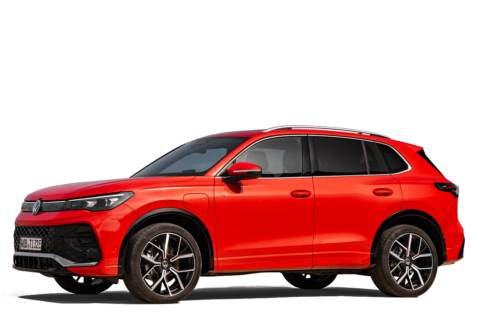
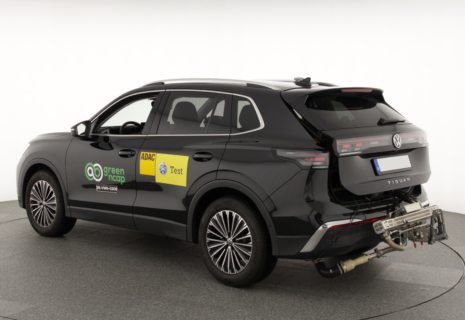
The VW Tiguan tested here is equipped with a 2‑litre diesel engine. The powertrain is not supported by any electrification and the achievements of this conventional small SUV remain limited.

  • Controls exhaust emissions effectively under all test conditions and achieves a high Clean Air score. Scores well for tyre abrasion but cannot reduce brake abrasion due to the lack of regenerative braking.
  • Delivers good diesel consumption for its class. Benefits from the absence of a large battery, but fuel use from the conventional engine limits the energy-efficiency score.
  • Keeps non-usage phase emissions relatively low, but fuel combustion still drives total life cycle emissions to 246 g CO2‑eq./km, resulting in a modest GHG score.
Read more Read less
6.6 10 Clean Air

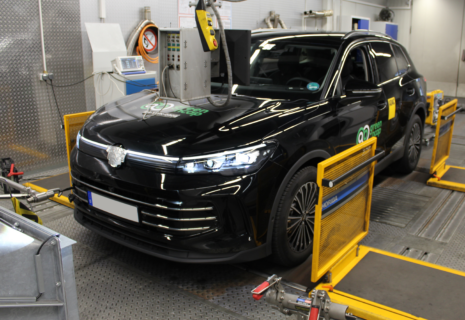
The Tiguan controls its exhaust emissions very well and robustly across all tests, including the winter cold start test and in the high-power demand Highway Test. None of the pollutant species require special attention, the performance is balanced and solid and achieves a high score. The points collected for tyre abrasion emissions are above average. However, the conventional powertrain is not capable of recuperative braking and there are no points rewarded for brake abrasion mitigation.

Exhaust emissions

adequate

8.7 10

good

8.410
NMHC NOX NH3 CO PN PM Score
Legal test (WLTP) 5.98
Warm weather 9.110
Highway 8.610
Winter cold start 8.510
Winter warm start 9.210

adequate

8.910
NMHC NOX NH3 CO PN PM Score
Real-world mixed drive 8.410
Short city trip 9.210
Congestion 2.02
  • good
  • adequate
  • marginal
  • weak
  • poor
  • n.a.
Non-exhaust emissions

marginal

3.1 10

adequate

3.76
Result Score
Influence of mass 1.73
Wheel alignment 1.01
Accelerator response 1.02

poor

0.06
Result Score
Brake dust mitigation 0.04
Brake dust containment 0.06
Recuperative braking - warm test 0.06
  • good
  • adequate
  • marginal
  • weak
  • poor
  • n.a.
Additional Life Cycle Assessment information

marginal

4.0 10
Pollutants
*Exhaust emissions are not contributing to the score in Additional Life Cycle Assessment information because they are scored in the Exhaust emissions section above.
5.1 10 Energy Efficiency

The car's diesel consumption figures are good but no more so than expected for this type of vehicle. In terms of life cycle assessment, the total primary energy demand benefits from the absence of a heavy battery, the production of which would increase the need for energy, but the amount of fuel needed by a conventional combustion engine limit the achievable score in this section.

Energy demand

weak

5.2 10

weak

2.310
Legal test (WLTP)
5.6 l/100 km
Warm weather
5.3 l/100 km
Highway
6.7 l/100 km
Winter cold start
6.6 l/100 km
Winter warm start
5.5 l/100 km

good

10.010
Total LCA energy consumption
*Direct propulsion energy share is not shown, it is included in ‘Fuel/energy supply’
Energy source share in total LCA consumption
Rolling resistance

marginal

3.7 10
  • good
  • adequate
  • marginal
  • weak
  • poor
  • n.a.
2.8 10 Greenhouse Gases

Although the non-usage LCA phases of a conventional vehicle emit less greenhouse gases than an electric car, the combustion of the fossil fuel significantly increases the emissions and leave the Tiguan with a low score in this part of the assessment, despite the reasonable consumption figures. The calculated total amount of life cycle greenhouse gas emissions is 246 g CO2‑eq./km.

Exhaust GHG emissions

weak

0.6 10
In laboratory
Legal test (WLTP)
148.4 g CO₂-eq./km
Warm weather
140.7 g CO₂-eq./km
Highway
181.1 g CO₂-eq./km
Winter cold start
178.2 g CO₂-eq./km
Winter warm start
148 g CO₂-eq./km
Additional Life Cycle Assessment information

adequate

8.7 10
Total LCA GHG Emissions
*The scoring does not consider the direct exhaust GHG emissions at the tailpipe, because they are scored separately in ‘Exhaust GHG emissions’ above.

Vehicle Life Cycle Average Emissions 59 (+/-)
(Best 52 | Worst 63)

  • good
  • adequate
  • marginal
  • weak
  • poor
  • n.a.

Specifications

  • Vehicle class Small SUV
  • Power/Torque 110 kW/360 Nm
  • Engine size 1,968 cc
  • Declared consumption 5.6 l/100 km
  • Declared CO2 146 g/km
  • Mass 1,702 kg
  • Heating concept Waste heat
  • Tyres 235/55R19
  • Emissions class Euro 6 EB
  • Tested car WVGZZZCT9TW58XXXX
  • Publication date 09 2026
Show less
Show more

Driving Experience

Consumption & Range

adequate

Estimated actual consumption What consumption can be expected in real world conditions?

adequate

Conditions Urban Rural Highway Mixed
Warm weather
7.1
5.0
5.8
6.0
l/100 km
Cold winter
8.8
5.6
6.3
6.9
l/100 km
Accuracy of display Is the consumption figure on the display correct?

good

  • good
  • adequate
  • poor
  • n.a.
Cold Winter Performance

not applicable

Charging Capability

not applicable

Green NCAP comments

The Driving Experience evaluation of conventional vehicles focuses only on the performance in section 'Consumption and Range'. The Tiguan's estimated real-world consumption figures are seen as adequate in all conditions – warm weather and cold winter, urban, rural, highway and mixed driving scenarios. The consumption readings on the computer display board are accurate.

Also covered by this rating

Variants

VW Tiguan

2.0 TDI ENERGY DSG diesel FWD automatic

VW Tiguan

2.0 TDI Life DSG diesel FWD automatic

VW Tiguan

2.0 TDI R-Line DSG diesel FWD automatic

VW Tiguan

2.0 TDI Trend DSG diesel FWD automatic

VW Tiguan

2.0 TDI DSG diesel FWD automatic