
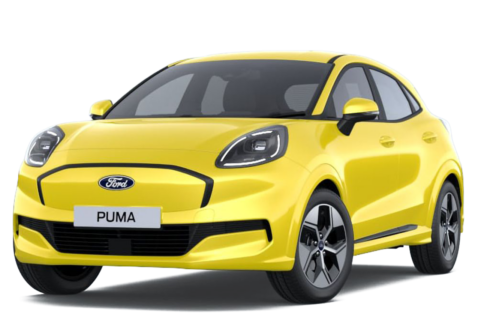
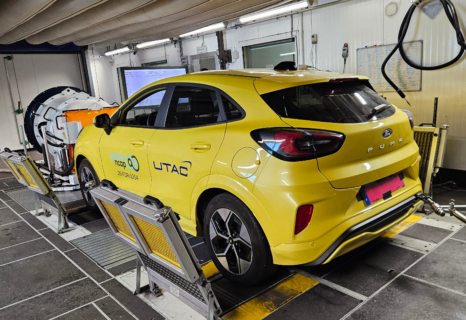
Ford Puma Gen-E electric FWD automatic
Sustainability rating
2026
96%
9.3
10
Clean Air
Exhaust emissions
good
10.0
10
good
10.010
| NMHC | NOX | NH3 | CO | PN | PM | Score | |
|---|---|---|---|---|---|---|---|
| Legal test (WLTP) | 8.08 | ||||||
| Warm weather | 10.010 | ||||||
| Highway | 10.010 | ||||||
| Winter cold start | 10.010 | ||||||
| Winter warm start | 10.010 |
good
10.010
| NMHC | NOX | NH3 | CO | PN | PM | Score | |
|---|---|---|---|---|---|---|---|
| Real-world mixed drive | 10.010 | ||||||
| Short city trip | 10.010 | ||||||
| Congestion | 2.02 |
Non-exhaust emissions
adequate
7.4
10
marginal
3.36
| Result | Score | |
|---|---|---|
| Influence of mass | 2.33 | |
| Wheel alignment | 1.01 | |
| Accelerator response | 0.02 |
good
5.66
| Result | Score | |
|---|---|---|
| Brake dust mitigation | 0.04 | |
| Brake dust containment | 0.06 | |
| Recuperative braking - warm test | 5.66 |
Additional Life Cycle Assessment information
adequate
9.0
10
Pollutants
*Exhaust emissions are not contributing to the score in Additional Life Cycle Assessment information because they are scored in the Exhaust emissions section above.
9.8
10
Energy Efficiency
Energy demand
good
9.8
10
good
10.010
Legal test (WLTP)
13.1
kWh/100 km
Warm weather
14.7
kWh/100 km
Highway
22.6
kWh/100 km
Winter cold start
27.6
kWh/100 km
Winter warm start
22.7
kWh/100 km
good
9.810
Total LCA energy consumption
*Direct propulsion energy share is not shown, it is included in ‘Fuel/energy supply’
Energy source share in total LCA consumption
Rolling resistance
good
10.0
10
10.0
10
Greenhouse Gases
Exhaust GHG emissions
good
10.0
10
In laboratory
Legal test (WLTP)
0.0
g CO₂-eq./km
Warm weather
0.0
g CO₂-eq./km
Highway
0.0
g CO₂-eq./km
Winter cold start
0.0
g CO₂-eq./km
Winter warm start
0.0
g CO₂-eq./km
Additional Life Cycle Assessment information
adequate
7.5
10
Total LCA GHG Emissions
*The scoring does not consider the direct exhaust GHG emissions at the tailpipe, because they are scored separately in ‘Exhaust GHG emissions’ above.
Vehicle Life Cycle Average Emissions 25 (+/-)
(Best 21 | Worst 28)
Specifications
- Vehicle class City and Supermini
- System power/torque 123.5 kW/290 Nm
- Engine size n.a.
- Declared consumption 13.1 kWh/100 km
- Declared driving range Overall 376 km City 523 km
- Declared CO2 n.a.
- Declared battery capacity Usable (net) 43.6 kWh Installed (gross) 54.0 kWh
- Mass 1,491 kg
- Heating concept PTC heater
- Tyres 215/55 R17
- Emissions class AX
- Tested car WF02XXERK1SM0XXXX
- Publication date 11 2026
Show less
Show more
Driving Experience
Consumption & Range
adequate
Estimated actual consumption
What consumption can be expected in real world conditions?
good
| Conditions | Urban | Rural | Highway | Mixed | |
|---|---|---|---|---|---|
| Warm weather |
14.6
|
15.2
|
18.2
|
15.8
|
kWh/100 km
|
| Cold winter |
27.7
|
21.6
|
25.8
|
25.1
|
kWh/100 km
|
Driving range
What driving range can be expected in real world conditions?
poor
| Conditions | Urban | Rural | Highway | Mixed | |
|---|---|---|---|---|---|
| Warm weather | 328 | 314 | 262 | 303 |
km
|
| Cold winter | 172 | 222 | 186 | 190 |
km
|
Accuracy of display
Is the consumption figure on the display correct?
good
Cold Winter Performance
poor
Driving range benefit of pre-warming
How much further can you drive in winter, if the car is pre-warmed?
poor
| Type | Driving Range Benefit | Result |
|---|---|---|
| Urban trip | + 61km | |
| Mixed trip | + 37km |
Cabin heating
Does the vehicle get warm quickly in winter?
poor
| Type | Front | Rear |
|---|---|---|
| Head area |
510s
|
497s
|
| Footwell |
1,047s
|
The rear footwell area did not reach target temperature of 16°C during the test.
Additional heating functions
What functions can be used to improve heating comfort?
| Y/N | Fitment | |
|---|---|---|
| Heat pump | ||
| Seat heating front | Optional | |
| Seat heating rear | ||
| Steering wheel heating | Optional | |
| Scheduled pre-heating of seats | ||
| Scheduled steering wheel pre-heating | ||
| Scheduled cabin air pre-heating | ||
| Smart cabin heating management |
Cabin thermal insulation
How well does the cabin maintain its temperature?
adequate
Good
Adequate
Poor
Charging Capability
adequate
Battery pre-conditioning
Does the vehicle have the ability to optimize the battery temperature for fast charging?
| Manual | Automatic | |
|---|---|---|
| Battery pre-conditioning |
Fast charging
good
Charging time
How quickly can the battery charge?
Recharged range gain per charging time
How long do you need to fast charge to drive a certain distance?
Charging power
How quickly does energy flow into the battery, depending on its charge level?
Home charging efficiency
Is charging at home efficiently utilizing the energy withdrawn from the grid?
adequate
| Home charging efficiency |
89%
|
|
| Maximum home charging power | 11 kW |
Bidirectional charging
How capable is the vehicle of supplying energy from its battery to other devices or systems?
poor
Power output
Not available
Compatibility
|
Vehicle-to-Load (V2L)
The inlet or the interior socket can provide AC power through an electrical domestic socket.
|
Vehicle-to-Household (V2H)
The vehicle can provide power to a household through a charger.
|
Vehicle-to-Grid (V2G)
The vehicle can return power to the grid.
|
Grid Integration
|
Basic
No integration (just a socket for a stand-alone load). No scheduling option. Very basic visualisation.
|
Limited
Energy management system through the vehicle app (timers availability and power monitoring). Dedicated interface in the car, with mobile app monitoring.
|
Advanced
Advanced: Advanced settings available such as tariff and consumption control, linked to distributor energy prices. Advanced real time energy flow visualization. AI powered suggestions for optimal usage.
|
Green NCAP comments
The Ford Puma Gen-E's electric's Driving Experience ranges from poor to adequate.
The Ford Puma Gen-E's electric's Driving Experience ranges from poor to adequate.
- The car shows ‘good' estimated real-world consumption values for warm weather conditions and mainly ‘adequate' figures in cold conditions. However, with the relatively small battery, which was found to deliver a useful capacity of only 42.4 kWh, the estimated real world driving range is regarded as ‘poor' in all scenarios and the car is rather suited for city and short distance trips. Drivers can trust the consumption figures shown on the display but need to remember that, as with every other electric vehicle, the displayed figures do not reflect the energy charged from the grid, but only the energy the vehicle uses from its battery. The amount needed to charge it is naturally higher.
- The heating performance of the car in ‑7°C cold start conditions is poor, and the rear footwell did not reach the target temperature of 16°C during the test. The driving range benefit from preconditioning the car prior to a cold weather trip while it is still plugged in, is marginal. The cabin thermal insulation is adequate – the cabin temperature dropped by 7.4°C after 30 minutes at ‑7°C with a deactivated vehicle.
- The standard home AC charging receives an ‘adequate' mark. Contrary to what might be expected for a car of this type, the fast DC charging performance is impressive. A 10‑80% battery recharge takes slightly more than 24 minutes. The vehicle doesn't offer any bidirectional charging functionalities.
Read more
Read less
Our verdict
Tested here is the Ford Puma Gen-E. This is a relatively light (1,491 kg empty mass) pure electric vehicle with a battery of 54 kWh installed capacity. This, together with the impressively low test consumption figures, give it a very high sustainability rating, typical only for really efficient, small and light EVs.