Our verdict

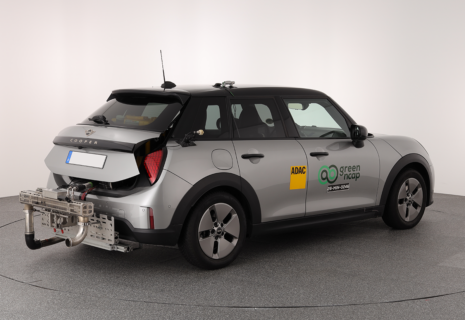
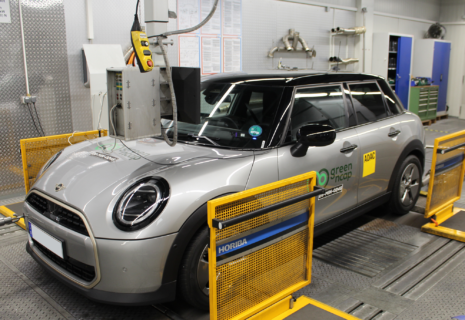
Tested here is the conventional version of the Mini Cooper with 115 kW and no powertrain hybridisation. Although this Mini is unable to achieve a high sustainability rating, it does well for its type and reaches an average score of 52%, which is enough for a well-deserved 3 stars rating. As expected, it does not disappoint with emissions control and collects a good number of points here. The weaknesses are related to the fossil fuel usage and the associated direct CO2 emissions.

  • Stable emission control, but weaker in cold start and high load. Good tyre abrasion, but no brake abrasion mitigation; life cycle pollutants reduce the final score.
  • Acceptable fuel use (6–7 l/100 km), but the lack of hybridisation lowers the propulsion efficiency. Low manufacturing energy demand improves the wholistic LCA result.
  • Lifecycle emissions are 229.6 g CO2‑eq./km, limiting the score. The low production emissions cannot offset the direct CO2 from fossil fuel combustion.
Read more Read less
6.4 10 Clean Air

The exhaust aftertreatment shows stable performance and demonstrates adequate and robust control, but valuable points are lost in the ‑7°C Winter cold start test and in the high-power demand Highway Test. In both cases the particle emissions increase and in the winter test Green NCAP's upper threshold is approached. The performance in the real-world test confirms the high expectations raised by the lab tests. While a good result is obtained for tyre abrasion, the car does not have any means to reduce its brake abrasion and received no points there. The final score in this index was lowered due to the pollutants associated with the manufacturing of the vehicle and the production of the fossil fuel.

Exhaust emissions

good

8.0 10

good

7.310
NMHC NOX NH3 CO PN PM Score
Legal test (WLTP) 5.98
Warm weather 8.510
Highway 6.810
Winter cold start 6.510
Winter warm start 8.510

adequate

8.910
NMHC NOX NH3 CO PN PM Score
Real-world mixed drive 8.010
Short city trip 9.510
Congestion 2.02
  • good
  • adequate
  • marginal
  • weak
  • poor
  • n.a.
Non-exhaust emissions

marginal

3.4 10

adequate

4.16
Result Score
Influence of mass 2.63
Wheel alignment 0.51
Accelerator response 1.02

poor

0.06
Result Score
Brake dust mitigation 0.04
Brake dust containment 0.06
Recuperative braking - warm test 0.06
  • good
  • adequate
  • marginal
  • weak
  • poor
  • n.a.
Additional Life Cycle Assessment information

marginal

4.8 10
Pollutants
*Exhaust emissions are not contributing to the score in Additional Life Cycle Assessment information because they are scored in the Exhaust emissions section above.
5.8 10 Energy Efficiency

The Mini is small and relatively light, so its absolute fuel consumption values are acceptable, but the lack of any hybridisation pushes the score for propulsion efficiency down – the test figures between 6 and 7 l/100 km are not overly impressive. Given the holistic LCA approach, the Energy Efficiency Index eventually appears better due to the low energy demand for the vehicle manufacturing.

Energy demand

weak

5.6 10

weak

2.910
Legal test (WLTP)
6.1 l/100 km
Warm weather
5.9 l/100 km
Highway
7.2 l/100 km
Winter cold start
6.9 l/100 km
Winter warm start
6 l/100 km

good

10.010
Total LCA energy consumption
*Direct propulsion energy share is not shown, it is included in ‘Fuel/energy supply’
Energy source share in total LCA consumption
Rolling resistance

adequate

7.9 10
  • good
  • adequate
  • marginal
  • weak
  • poor
  • n.a.
3.7 10 Greenhouse Gases

The total life cycle greenhouse gas emissions are estimated to be 229.6 g CO2‑eq./km, which is enough for a sore of 3.7/10. The direct emissions contribute to this amount with 146 g CO2‑eq./km. The low greenhouse gas emissions of the production of the vehicle cannot compensate for the high emissions of combusting the fossil fuel.

Exhaust GHG emissions

weak

1.4 10
In laboratory
Legal test (WLTP)
137 g CO₂-eq./km
Warm weather
133.7 g CO₂-eq./km
Highway
165 g CO₂-eq./km
Winter cold start
157.4 g CO₂-eq./km
Winter warm start
137.1 g CO₂-eq./km
Additional Life Cycle Assessment information

good

9.0 10
Total LCA GHG Emissions
*The scoring does not consider the direct exhaust GHG emissions at the tailpipe, because they are scored separately in ‘Exhaust GHG emissions’ above.

Vehicle Life Cycle Average Emissions 55 (+/-)
(Best 51 | Worst 60)

  • good
  • adequate
  • marginal
  • weak
  • poor
  • n.a.

Specifications

  • Vehicle class City and Supermini
  • Power/Torque 115 kW/230 Nm
  • Engine size 1,499 cc
  • Declared consumption 6.1 l/100 km
  • Declared CO2 137 g/km
  • Mass 1,346 kg
  • Heating concept Waste heat
  • Tyres 185/60R16 90H
  • Emissions class Euro 6 EC
  • Tested car WMW41GD0402X7XXXX
  • Publication date 06 2026
Show less
Show more

Driving Experience

Consumption & Range

adequate

Estimated actual consumption What consumption can be expected in real world conditions?

adequate

Conditions Urban Rural Highway Mixed
Warm weather
8.4
5.5
6.3
7.5
l/100 km
Cold winter
9.6
5.9
6.8
8.3
l/100 km
Accuracy of display Is the consumption figure on the display correct?

good

  • good
  • adequate
  • poor
  • n.a.
Cold Winter Performance

not applicable

Charging Capability

not applicable

Green NCAP comments

The Driving Experience evaluation of conventional vehicles focuses only on the performance in the section 'Consumption and Range'. The Mini Cooper C's estimated real-world consumption figures receive an 'adequate' mark for all scenarios. The consumption readings on the board computer display are accurate.

Also covered by this rating

Variants

MINI Cooper

C Classic Trim Steptronic – 3/5 doors petrol FWD automatic

MINI Cooper

C Essential Trim Steptronic – 3/5 doors petrol FWD automatic

MINI Cooper

C Favoured Trim Steptronic – 3/5 doors petrol FWD automatic

MINI Cooper

C JCW Trim Sportgetriebe – 3/5 doors petrol FWD automatic

MINI Cooper

C Blackyard Steptronic – 3/5 doors petrol FWD automatic