Our verdict

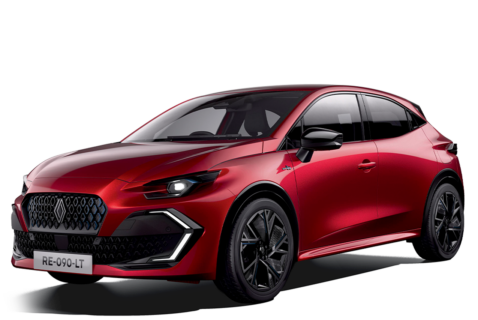
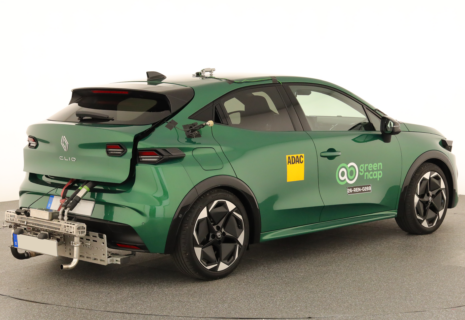
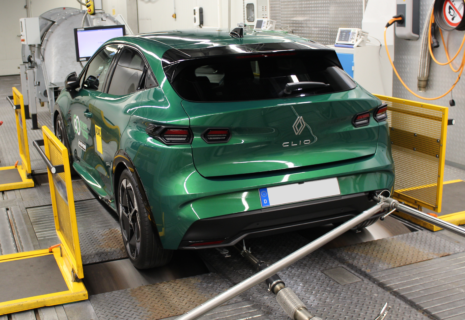
Tested here is the new Renault Clio, in its TCe115 version, which is a conventional petrol powertrain without any hybridisation. Yet the compact and light Clio impressed with a 3½ stars rating and a relatively high score of 62% percent. This impressive achievement is possible thanks to the low mass and efficient petrol engine, although fossil fuel consumption sets limits.

  • Controls exhaust emissions effectively and robustly, though potential aftertreatment improvements would further improve the score. Benefits from low mass and smooth accelerator response to minimize tyre abrasion but cannot reduce brake abrasion due to the lack of regenerative braking.
  • Delivers good fuel consumption, recording 5.0 l/100 km on-road and 6.1 l/100 km in urban driving. Benefits from low mass and the absence of a heavy battery, reducing life cycle energy demand.
  • Achieves a relatively strong GHG score for a combustion vehicle thanks to reasonable consumption, low mass, and European production. Limits life cycle emissions to 207 g CO2 eq./km, including 133 g CO2 eq./km from fuel combustion.
Read more Read less
6.8 10 Clean Air

The Clio controls its exhaust emissions well and robustly, but some improvements would help achieve an even higher score, e.g. further reduction of CO and particle number emissions in the cold start ‑7°C Cold Ambient Test. Remarkably, the tested emissions were lower than what the type-approval values would lead one to expect. Almost all points are collected for tyre abrasion thanks to low mass and smooth accelerator pedal behaviour, but the conventional powertrain is not able of recuperative braking and there are no points rewarded for brake abrasion mitigation.

Exhaust emissions

adequate

7.8 10

good

7.310
NMHC NOX NH3 CO PN PM Score
Legal test (WLTP) 5.08
Warm weather 8.610
Highway 7.710
Winter cold start 6.610
Winter warm start 8.210

adequate

8.410
NMHC NOX NH3 CO PN PM Score
Real-world mixed drive 7.610
Short city trip 8.810
Congestion 2.02
  • good
  • adequate
  • marginal
  • weak
  • poor
  • n.a.
Non-exhaust emissions

marginal

4.6 10

good

5.56
Result Score
Influence of mass 3.03
Wheel alignment 0.51
Accelerator response 2.02

poor

0.06
Result Score
Brake dust mitigation 0.04
Brake dust containment 0.06
Recuperative braking - warm test 0.06
  • good
  • adequate
  • marginal
  • weak
  • poor
  • n.a.
Additional Life Cycle Assessment information

adequate

6.0 10
Pollutants
*Exhaust emissions are not contributing to the score in Additional Life Cycle Assessment information because they are scored in the Exhaust emissions section above.
7.1 10 Energy Efficiency

The car's petrol consumption figures are good but not surprising for this type of vehicle. The on-road test was performed on a dry road in sunny weather and recorded a consumption of 5 l/100 km with 6.1 l/100 km in the short urban trip. In terms of life cycle assessment, the total primary energy demand further benefits from the low mass and the absence of a heavy battery.

Energy demand

marginal

6.9 10

marginal

3.910
Legal test (WLTP)
5.2 l/100 km
Warm weather
5.2 l/100 km
Highway
6.4 l/100 km
Winter cold start
6.7 l/100 km
Winter warm start
5.6 l/100 km

good

10.010
Total LCA energy consumption
*Direct propulsion energy share is not shown, it is included in ‘Fuel/energy supply’
Energy source share in total LCA consumption
Rolling resistance

good

10.0 10
  • good
  • adequate
  • marginal
  • weak
  • poor
  • n.a.
4.9 10 Greenhouse Gases

Although the Greenhouse Gas Index is the most difficult category for conventionally powered vehicles, the Clio manages to collect almost half of the available points. The reasonable consumption figures, the low mass and the production in Europe help here. The calculated total amount of life cycle greenhouse gas emissions is 207 g CO2‑eq./km, of which 133 come directly from petrol combustion.

Exhaust GHG emissions

weak

2.2 10
In laboratory
Legal test (WLTP)
118.1 g CO₂-eq./km
Warm weather
118.9 g CO₂-eq./km
Highway
145.8 g CO₂-eq./km
Winter cold start
152.9 g CO₂-eq./km
Winter warm start
127.4 g CO₂-eq./km
Additional Life Cycle Assessment information

good

9.7 10
Total LCA GHG Emissions
*The scoring does not consider the direct exhaust GHG emissions at the tailpipe, because they are scored separately in ‘Exhaust GHG emissions’ above.

Vehicle Life Cycle Average Emissions 50 (+/-)
(Best 45 | Worst 55)

  • good
  • adequate
  • marginal
  • weak
  • poor
  • n.a.

Specifications

  • Vehicle class Small Family Car
  • Power/Torque 84 kW/190 Nm
  • Engine size 1,199 cc
  • Declared consumption 5.2 l/100 km
  • Declared CO2 118 g/km
  • Mass 1,186 kg
  • Heating concept Waste heat
  • Tyres 205/45 R18
  • Emissions class Euro 6 EC
  • Tested car VF1R030007483XXXX
  • Publication date 09 2026
Show less
Show more

Driving Experience

Consumption & Range

good

Estimated actual consumption What consumption can be expected in real world conditions?

good

Conditions Urban Rural Highway Mixed
Warm weather
7.6
4.9
5.5
6.8
l/100 km
Cold winter
9.5
5.6
6.2
8.0
l/100 km
Accuracy of display Is the consumption figure on the display correct?

good

  • good
  • adequate
  • poor
  • n.a.
Cold Winter Performance

not applicable

Charging Capability

not applicable

Green NCAP comments

The Driving Experience evaluation of conventional vehicles focuses only on the performance in section 'Consumption and Range'. The Clio's estimated real-world consumption figures are mostly seen as adequate, with the rural and highway warm weather scenarios being evaluated as good. The consumption readings on the computer display board are accurate.

Also covered by this rating

Variants

Renault Clio

TCe 115 Evolution petrol FWD manual